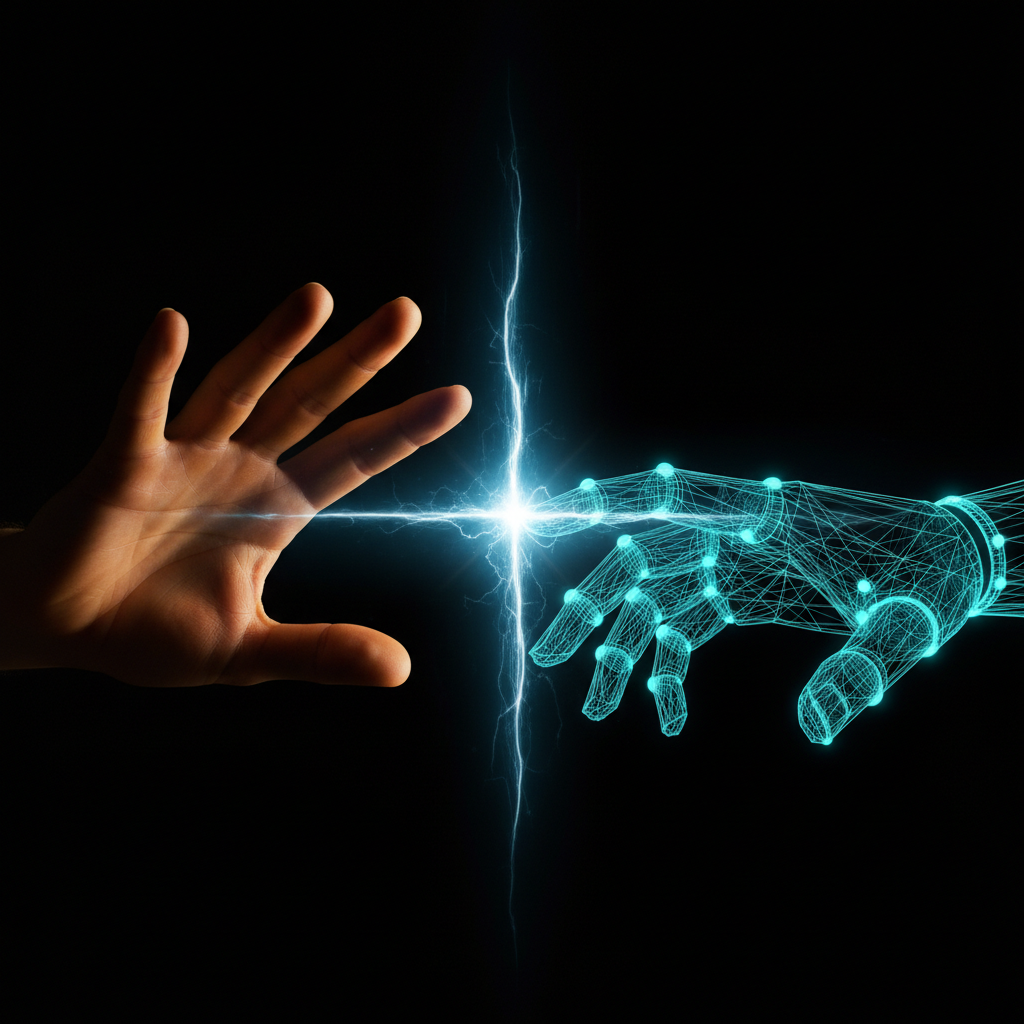
Losing to AI hurts less than losing to humans — until it doesn’t. The critical variable is identity investment, and understanding it is the key to designing a game people actually want to replay.
In 2024, researchers at Angelo State University set up a simple experiment: seventy-seven participants competed in an emotion-recognition task and were told they lost. Half believed they’d lost to another person. Half believed they’d lost to an AI. The researchers expected the AI group to feel worse — lower self-esteem, higher stress, diminished confidence. The opposite trend emerged. Participants who thought they’d been beaten by an AI reported slightly higher self-efficacy (M=3.16 vs. M=2.99) and more favorable attitudes toward the technology that had just defeated them.
The mechanism is elegantly simple: externalization. When you lose to a machine, you can file the defeat under “computational superiority” — a category entirely separate from your own worth. The AI is a fundamentally different kind of entity, so losing to it carries almost no social comparison threat. Losing to another human, by contrast, delivers a direct verdict. Someone who shares your biology, your sleep schedule, your caloric needs simply outperformed you. That stings.
This finding upends the intuitive assumption that AI opponents are psychologically more threatening than human ones. But the study’s limitations reveal a critical boundary condition. The task was trivial — identifying emotions in dance videos. The stakes were negligible. None of the measured differences reached statistical significance. The ego shield held because nobody’s identity was on the line.
What happens when it is?
Garry Kasparov did not merely lose to Deep Blue in 1997. He disintegrated during the match. In the pivotal second game, the world chess champion resigned a position that computer analysis later showed was drawable — his psychological state had deteriorated so completely that he could no longer evaluate the board accurately. Two decades later, Kasparov described the experience as “a very painful experience” and made a revealing admission: discovering that Deep Blue had not actually played brilliantly made the loss worse, not better, because it exposed how totally his mental composure had collapsed. The externalization defense — “well, machines just calculate faster” — failed precisely because chess calculation was Kasparov’s entire identity. You cannot shrug off defeat in the domain that defines you.
Lee Sedol’s trajectory was slower and, in some ways, more devastating. After losing 4-1 to AlphaGo in 2016, Sedol continued competing against human opponents for three more years. Then, in 2019, he retired with a statement that reads less like a sports announcement and more like a philosophical surrender: “Even if I become the number one, there is an entity that cannot be defeated.” The ceiling that had structured his entire motivation — being the best — no longer existed. It had been replaced by an opponent that did not tire, did not get nervous, and had no upper bound on improvement.
The same AI opponent produces ego-shielding in low-stakes contexts and existential devastation in high-stakes ones. The difference is not the AI — it is how much of yourself you have invested in the domain.
Fan Hui, the European Go champion who trained extensively with AlphaGo before the Sedol match, described the psychological experience in terms that evoke therapy more than competition:
“The first time you see this, you don’t want to see because ‘Oh, this is real me?’ And more than more, you need accept.”
— Fan Hui, European Go Champion
The machine functioned as a mirror that showed players the precise gap between their actual skill and theoretical perfection — a gap they had previously been able to ignore because no human opponent could expose it completely. Every human opponent shares your limitations. An AI does not. That asymmetry transforms competition from a test of relative skill into a confrontation with absolute limits.
The critical variable separating the ego shield from the existential crisis is identity investment. When the task is peripheral to who you are — identifying emotions in dance videos, playing a casual browser game — losing to AI is easy to externalize. When the task is central to your identity — when you are the greatest chess player alive or have devoted your life to Go — AI exposes the limits of human potential in a way no human opponent ever could.
The documented human-vs-AI competitions reveal a spectrum of professional responses that maps neatly onto the identity-investment axis. At one extreme, Lee Sedol quit. At the other, professional poker players studied harder than ever before.
The poker community’s response to losing to Libratus (2017) and Pluribus (2019) was almost joyful. Michael “Gags” Gagliano, one of the professionals who competed against the AI, called the experience “incredibly fascinating” and noted that “there were several plays that humans simply are not making at all, especially relating to its bet sizing.” The poker pros treated their AI opponent as a tutor, not a threat, and for a structural reason: the AI was never going to sit at the World Series of Poker main event. Their actual competitors remained other humans, and the AI had just handed them a playbook of profitable strategies those humans had not discovered. The machine improved their careers.
The StarCraft community’s response to AlphaStar fell somewhere in the ambivalent middle. MaNa, who lost 5-0 to DeepMind’s agent, expressed genuine admiration, saying the experience “put the game in a whole new light.” But the broader community exhibited a classic psychological defense sequence: unwarranted confidence before the match, followed by frantic rationalization afterward. When AlphaStar won, players immediately debated whether the victory was “real,” fixating on mechanical advantages — did the AI win because it clicked faster, or because it actually thought better?
One community analyst captured the deeper disruption: “AlphaStar is not scared about the ramp. If I am playing against a human player right there, nobody is going up that ramp.” Human strategy, it turned out, was built on assumptions about opponent psychology — assumptions about fear, caution, and emotional tilt that simply did not apply to a machine. The AI did not violate the rules of the game. It violated the unwritten rules of human caution.
Key insight: Three conditions determine whether AI defeat motivates or demoralizes: (1) a path forward exists, (2) the loss is framed as information rather than verdict, and (3) the stakes feel renewable rather than terminal.
The pattern across all four major cases — chess, Go, poker, StarCraft — resolves into three conditions that determine whether an AI defeat becomes motivating or demoralizing. First, the human needs a path forward: either by learning from the AI (poker) or by continuing to compete in a domain where the AI is not a permanent fixture. Second, the defeat needs to be framed as information rather than verdict — “here is what optimal play looks like” rather than “you are inadequate.” Third, the stakes need to feel renewable: losing one round of a two-minute browser game is a spark; losing the domain that structures your entire identity is an extinction event.
These three conditions function as a design checklist. Short rounds guarantee renewability. Transparent AI behavior frames defeat as a puzzle to decode rather than a judgment rendered. And the casual context of a browser game keeps identity investment low enough for the ego shield to hold. The harder question is whether a game can generate genuine competitive intensity — the kind that makes players retry and share — without pushing identity investment past the threshold where the shield breaks.
The question of what makes a loss motivating rather than demoralizing has a surprisingly specific neurological answer. A landmark 2009 fMRI study by Clark et al. at the University of Cambridge examined near-miss experiences — those moments when you almost win but don’t — and found something paradoxical. Near-misses activated the ventral striatum, anterior insula, and rostral anterior cingulate cortex: the same dopamine-driven reward circuits that fire during actual wins. Participants rated near-misses as unpleasant, yet simultaneously reported increased desire to continue playing. The brain treats “almost winning” as evidence that winning is imminent, even when the outcome was entirely random.
But the study contained a crucial detail that changes everything for game design. The near-miss effect was strongest when participants had personal control over their selections. Near-misses generated by the computer — where the machine determined how close the outcome was — actually reduced motivation to play.
This distinction maps directly onto AI game design. If the player’s choices determine how close they get to winning — if they can see the strategy that almost worked, the move that nearly outmaneuvered the AI — the retry impulse fires hard. If the game feels like the AI is calibrating difficulty to manufacture closeness (which is exactly what adaptive difficulty systems do), the effect collapses. Players can sense the difference between genuine competition and a patronizing simulation of it. The game needs to feel like authentic agency produced the near-miss, even if, behind the scenes, some difficulty management is happening.
Geoffrey Engelstein’s research on loss aversion in games reveals a complementary principle. Players react more strongly to losing progress they already had than to failing to gain new progress — the same mathematical outcome triggers different emotional responses depending on whether it is framed as loss or as unrealized gain. The implication for AI game design is precise: the AI’s advantage should never manifest as taking things away from the player. Instead, the AI should gain things the player fails to capture. Giving the AI a boost produces the same competitive asymmetry as penalizing the player, but the psychological response is fundamentally different. One feels like unfair punishment. The other feels like a challenge to play faster.
Design principle: AI should fail you forward. The AI gains advantages, the player fails to gain — never the reverse. Same math, radically different emotional response.
Research on AI behavior in games reveals a counterintuitive design principle: AI opponents that almost behave like humans trigger stronger negative reactions than opponents that are either clearly human or clearly artificial. The uncanny valley, typically discussed in terms of visual appearance, applies equally to behavior. In Half-Life 2, a companion character’s eyes slowly tracking the player during an elevator ride — then flicking back when “caught” — destroyed immersion more effectively than a completely non-human character would have. Players are remarkably attuned to behavioral fakes, and detecting one triggers something closer to disgust than disengagement.
Connection: This connects to the cultural analysis: the authenticity premium driving anti-AI sentiment extends to gameplay itself. Players punish perceived fakeness in AI opponents just as consumers punish perceived fakeness in AI-generated content.
The awareness effect cuts both ways. A 2024 PNAS study found that when people know they are being evaluated by AI, they strategically modify their behavior — emphasizing analytical characteristics and downplaying intuition. In competitive contexts, knowing your opponent is a machine strips away a significant portion of the human strategic toolkit: bluffing, reading emotional cues, exploiting tilt, detecting hesitation. Poker professionals noted that AI opponents had no tells, no emotional patterns, and no fear of going broke. The game shifted from a psychological contest to a mathematical one. In StarCraft, human strategy built on assumptions about opponent fear became useless against an AI that marched up the ramp with zero hesitation. Players don’t just lose tools when facing AI — they unconsciously reshape their own behavior to become more machine-like, which is precisely the opposite of what a “celebrate your humanity” game should encourage.
The design principle that emerges from both the uncanny valley research and the ego-shield effect converges on the same recommendation: make the AI proudly, transparently artificial. An AI opponent that leans into its mechanical nature — geometric, precise, unhesitating — is both less likely to trigger uncanny-valley disgust (because it never enters the “almost human but wrong” zone) and more likely to activate the ego shield (because losing to an alien entity is easier to externalize than losing to a simulated person). The chess industry’s approach of giving AI bots human names and portraits is exactly wrong for a competitive context. The cultural moment demands machine-ness.
Social identity theory, established by Henri Tajfel in 1978, predicts that framing competition as a group contest between “humans” and “machines” should activate in-group loyalty dynamics absent from individual matchups. The limited research supports this prediction. Studies on intergroup competition show that group-level contests produce significantly more engagement, emotional investment, and aggression than individual ones. When you compete not just as yourself but as a representative of your species, the emotional stakes escalate — but they also distribute.
Research on human-agent interaction using social identity frameworks found that people readily categorize AI as an out-group and apply classic in-group/out-group dynamics. One experiment demonstrated that when robots behaved autonomously without human oversight, participants exhibited negative reactions toward robots generally — suggesting that perceived violation of human supremacy triggers collective defensive responses. This “species loyalty” effect, channeled into a game, could transform individual performance anxiety into collective purpose.
The cultural template for this transformation already exists: John Henry. The folk hero who raced a steam drill and won — only to die from the effort — captures something deep about the human relationship with machines. The compulsion to prove that flesh and determination can overcome mechanical superiority, even at great personal cost, is not rational. It is mythological. And mythology drives behavior in ways that rational cost-benefit analysis does not.
Risk: If the collective narrative becomes “humanity is losing,” demoralization may be worse than individual defeat because it attacks species identity. The design needs a mechanism for collective progress — even individual losses must contribute to a visible aggregate score.
The difference between a game that asks “can you beat this AI?” and one that asks “can humanity beat this AI?” is the difference between individual performance anxiety and collective purpose. The latter is more viral because sharing results becomes an act of solidarity rather than boasting. “I lost” is a confession. “We’re fighting the machines” is a rallying cry. And rallying cries spread faster than confessions.
The psychological architecture for a human-vs-AI browser game is now clear: keep identity investment low, maintain player agency to preserve the near-miss engine, frame losses as information rather than verdicts, make the AI visibly artificial, and wrap the whole experience in a collective narrative that transforms individual defeat into shared purpose. The question that remains is more concrete: what specific game mechanics can exploit the asymmetry between human and artificial intelligence?